
The Trip
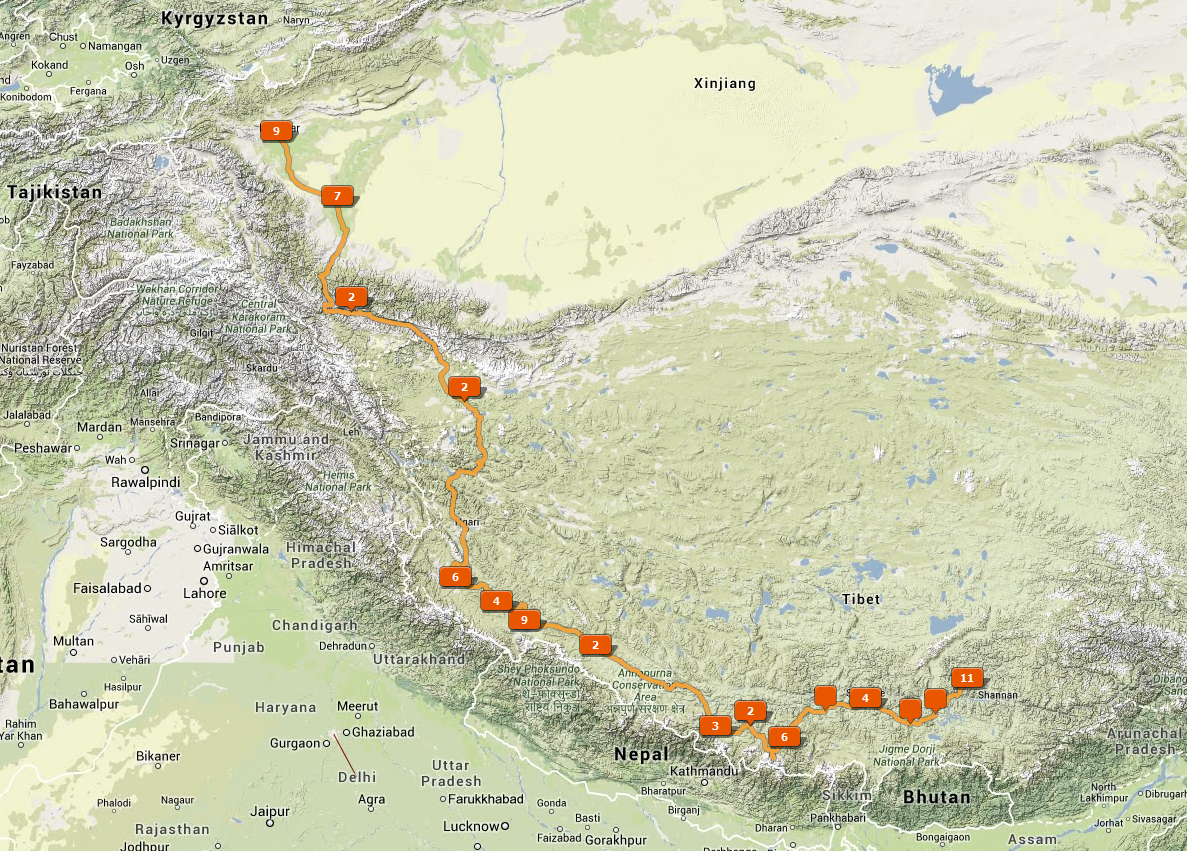
This album is from a journey across Tibet made in September 2013. After a couple of days in Shang Hai the trip started in Lhasa and headed west some 3,500km to Kashgar in the Xinjiang Autonomous Region.
One of the most memorable activities is to join the Tibetans on their morning
At Sera Monastery the monks debating tradition, which is punctuated with loud slapping of hands. Each time a new question is asked, the teacher strikes his outstretched left palm with his right palm. When a question is answered correctly, it is acknowledged by the teacher bringing the back of his right hand to his left palm. The debates facilitate better comprehension of the Buddhist philosophy.
This exemplary debating tradition supplemented with gestures is said to be exclusive to this monastery, among the several other monasteries of Lhasa.
Some Chinese tourists were making heavy use of oxygen cylinders as they journeyed to the basecamp and viewpoints.
The King’s palace is located on the upper part of the hills. It has a maze of chambers, and a balcony and windows looking down into the dry valley. They have fallen into decay except for a few temples which have survived on the lower flanks of the ridge. Their walls are studded with mural art and are now an under-appreciated museum.
This lake in Aksai Chin is not shown on the google map of the area -- but it does, of course, appear in satellite images.
The Route
The route began in Lhasa the capital of the Tibet Autonomous region, and headed west to follow the line of the Himalayas passing the snow-capped peaks of Bhutan, Sikkim, Nepal, Gharwal and Ladakh, to end at the oasis town of Khasgar, home to the Uighur community in the Xinjiang Autonomous Region. Along the way notable places included Everest, a trek around the sacred Mount Kailash, the ancient Kingdom of Guge and crossing the disputed territory of Aksai Chin. And finally, the contrast between the high Tibetan plateau and the bustling Kashgar markets is stark.
Lhasa
Lhasa, once the home of the Dalai Lama, is now dominated by the Chinese. The levels of surveillance and security are disturbing. The numbers of Chinese tourists can overwhelm the temples. There is something disheartening about racing through the Potala Palace (a 1 hour time limit is imposed), and seeing solitary monks hiding in small recesses, reciting their scriptures, as Chinese tourists stream past.
Landscape
Outside Lhasa the countryside opens up and the extensive landscape with views over the plateau to the high peaks to the south unceasingly impressive. The route crosses numerous 5,000m passes, all covered in prayer flags, and many lakes. The road West is always high, rarely below 4,500m.
Everest
A detour to the tourist base camp for Mount Everest offers views of the summit, if at the cost of a sleepless night at 5,200m. The base camp can be reached by road, the climbing base camp being higher up the valley.
Mount Kailash Kora
Mount Kailash is sacred to the followers of four religions, Buddhist, Hindu, Bon Po and Jain. A circuit of the mountain covers 52 km and should be completed once in a pilgrim’s life. See Mount Kailash page.
Kingdom of Guge
The Guge kingdom was founded in the 10th century in Western Tibet, about 2000km from Lhasa. Guge fell to Ladakh troops in 1630 and then again in 1670 to troops from central Tibet, under the leadership of the 5th Dalai Lama. Now the remains of temples atop an impenetrable hill form perhaps the most impressive and least known site in Tibet.
Aksai Chin
Aksai Chin is a disputed border area between China and India. It is administered by China as part of Xinjiang Autonomous Region, but is claimed by India as a part of Ladakh. In 1962 China and India fought a brief war over Aksai Chin, but in 1993 and 1996 the two countries signed agreements to respect the Line of Actual Control.
Kashgar and Xinjiang
Xinjiang is home to the Turkic Uighur people. Kashgar, or Kashi, is an oasis town with approximately 350,000 people and is the westernmost Chinese city, located near the border with Tajikistan and Kyrgyzstan. The Sunday Market in Kashgar is renowned as the biggest market in central Asia. The market is active every day but Sunday is the biggest in scale and includes a livestock market and a now covered market for other goods.


The Trip
This trip covered 3,500km from Lhasa (Tibet) to Kashgar in Xinjiang, with detours to visit Everest from the north side and join the pilgrims walking around Mount Kailash. Read More...